When planning to undergo a surgical procedure to correct your enlarged male breasts, it is essential to understand the key differences between popular invasive techniques, as they can make a huge difference in contouring the chest. With advancements in modern surgical methods and liposuction for gynecomastia for males, it is now possible for you to select the right option to correct gynecomastia and achieve the ideal chest. It is not just an issue of preference when deciding between a chest liposuction or gland removal gynecomastia surgery, or both combined. The distinct anatomy of your chest, aesthetic needs, and breast tissue composition have major roles to play in influencing the choice of the right surgical technique to achieve the desired outcome. While 70% of the males have found the outcome of high-definition lipo as satisfactory, others would need gland removal surgery[1]. So, it is important to understand these major differences between the surgical approaches to make an informed decision about the gynecomastia treatment path.
Understanding Male Chest: Glandular Tissue vs Fat
As a male, you must know that your chest is made up of two tissue variants – glandular and adipose tissue, which can also lead to enlarged breasts. The fat tissue in the breast feels soft when you touch it. This type of chest tissue is responsive to workouts and diet changes, but stubborn chest fat needs surgery to eliminate it.
Glandular tissue is disc-like and feels firm and rubbery, located just behind the areolar-nipple area. This type of chest tissue isn’t responsive to modifications you make to your lifestyle and is much different than the fat deposited in other parts of your body. However, most males facing gynecomastia tend to have a blend of both these types of tissues, with one dominant type influencing the right surgical technique.
It is common for men to have both these tissues in different ratios. It causes some people to develop fat-based breast enlargement referred to as pseudogynecomastia, which develops when you age or gain weight. Others will develop true gynecomastia caused by genetics, hormone changes, and medications owing to excess glandular tissue. In some cases, men will have a combination of both these conditions, which might demand a combined approach of gland removal, gynecomastia surgery, and liposuction to treat gynecomastia[2].
How is Tissue Composition Diagnosis Performed?
Using special examination techniques, Dr. Ram Bhupal Rao would make an assessment of tissue composition. He will identify the glandular tissue from fat tissue by isolating the layers of tissue during physical examination. While glandular tissue in the chest will not be compressed by fingers while retaining the disc shape, fat tissue will be uniform, soft, and will be pressed between fingers. This examination will also help identify trait patterns of the chest tissues and determine whether you have pseudogynecomastia or true gynecomastia[3]. Fat tissue in the chest will have even distribution with a diffused appearance with no firm feel near the nipple. Glandular tissue will be fuller around the nipple, making the areola appear puffy and protruding. Sometimes, mammography or ultrasound might be needed to identify the location of tissue accumulation, its thickness, and size to plan the surgery accurately and achieve the realistic goals and expectations.
Why Tissue Composition is a Deciding Factor for Surgical Techniques
The success rate of liposuction for gynecomastia mostly relies on rectifying the major tissue type that has caused breast enlargement. Excess chest fat is highly responsive to the liposuction method, as the surgeon at the Akruti Plastic & Cosmetic Surgery Centre would be able to make tiny incisions placed strategically to achieve the desired chest contour by sculpting the tissues. But it is not effective for removing glandular tissue through lipo cannula tubes, which is why it demands an excision method. Such biological differences, your breast glandular tissue is fibrous, which cannot be removed through suction, and trying to remove it through liposuction will make the breasts look irregular or cause deformity. So, about 30% of the males with gynecomastia cannot be rectified with just liposuction but will need gland removal gynecomastia surgery.
Having a clear idea about your tissue composition will help identify the right surgical method to achieve natural and desired outcomes. Experienced and well-qualified surgeon like Dr. Ram Bhupal Rao will make an accurate diagnosis to identify your chest tissue type and recommend the suitable surgical technique to rectify gynecomastia and get the best results.
Liposuction vs. Gland Removal: Learning Key Differences
It can be challenging for you to choose between gland removal, gynecomastia surgery, and liposuction to correct your enlarged breast issue. Here’s how both these procedures for breast enlargement tend to differ:
1. Targeted Tissue Type Is Different
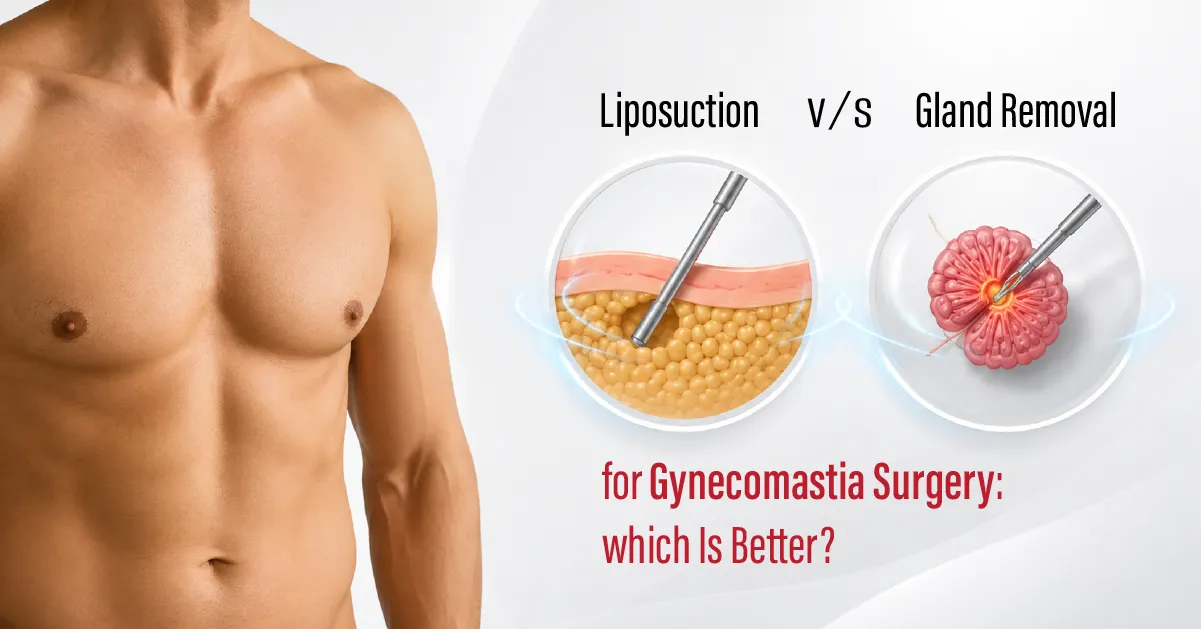
The major difference between gland removal gynecomastia surgery and liposuction is that each treatment is designed to target a different chest tissue. Liposuction for gynecomastia will help eliminate the stubborn fat accumulated in your chest by inserting tiny cannula through small incisions to remove excess chest fat through suction action. This surgical method is ideal for men dealing with enlarged breast or pseudogynecomastia triggered by excess fat[4].
The dense glandular tissue in the breast causing gynecomastia will be removed by gland removal gynecomastia surgery. The tissue will develop behind the nipple region, triggering true gynecomastia. As this type of chest tissue is fibrous and firm, removing it through the lipo method is not possible. So, the excision procedure helps in removing the glandular tissue completely to achieve a contoured chest.
2. Effectiveness in Correcting True Gynecomastia
Though liposuction for gynecomastia is beneficial for enhancing your chest’s overall look when too much fat is the key concern, it is not advisable for rectifying true gynecomastia. As the firm chest tissue is placed just below the nipple, the chest will look protruding even after the fat is removed. However, gland removal, or gynecomastia surgery, on the other hand, is an effective treatment for resolving true gynecomastia as it is performed to remove the breast gland permanently. It focuses on eliminating the root cause of the enlarged chest instead of just cutting down excess fat surrounding the nipple. So, people having severe to moderate grade gynecomastia will get better outcomes through excision surgery.
3. Rectifying Puffy and Protruding Nipples
Males with gynecomastia tend to develop an inferiority complex and lose their confidence when their nipple area becomes puffy and protruding. It is caused when excess glandular tissue presses the nipple and areola, making it push forward, causing a protruding appearance. While liposuction for gynecomastia is effective for reducing the chest volume, it cannot reduce the puffy nipple condition, as there is a dense gland present behind the nipple.
Though you might notice a subtle difference, your central chest region remains protruding. This is why gland removal gynecomastia surgery is an effective choice for rectifying protruding or puffy nipples. This procedure helps in removing the dense gland present below the areola, offering a flatter and smoother chest profile.
4. Surgical Procedure and Techniques
The techniques employed by gland removal, gynecomastia surgery, and liposuction are totally different. Liposuction refers to minimally invasive surgery that is performed by making minute incisions to insert a cannula tube to suck fat effectively. As the fat is expelled through suction, it is minimally invasive and will leave tiny scars. The gland excision procedure requires an expert surgeon like Dr. Ram Bhupal Rao with high precision and extensive surgical practice to get the desired results. Your surgeon will make tiny incisions along the areola’s border to remove the glandular tissue effectively.
4. Chest Contouring Ability
When it is about sculpting or contouring enlarged breasts, liposuction has an edge over gland removal and gynecomastia surgery. Lipo procedure is performed for removing stubborn fat from the chest area to make the chest wall appear smooth and flawless. But liposuction will not be able to achieve a flatter chest profile when fibrous glandular tissue surrounds it, making it appear puffy. Excision surgery is an ideal choice to correct glandular tissue enlargement in a male’s chest. When used in combination with liposuction, you will be able to flaunt a naturally sculpted chest without excess fat and glandular tissue.
5. Suitability For Gynecomastia Grades
Your surgeon at Akruti Plastic & Cosmetic Surgery Centre would suggest the right surgical procedure after evaluating and assessing the extent of gynecomastia. If you have a subtle level of enlarged breasts triggered by excess fat, liposuction for gynecomastia would be a suitable choice. This surgical procedure is an ideal decision as your chest will have less glandular tissue and excellent skin elasticity. If you have a severe to moderate level of breast enlargement, then gland removal, or gynecomastia surgery, would be the best suggestion. This type of excision method can remove denser and larger breast glands without leaving any traces behind.
6. Scarring Level
It is natural for you to have concerns about scarring before undergoing gland removal gynecomastia surgery. As liposuction requires the surgeon to make dot-like incisions to insert a cannula, they heal quickly and don’t form visible scars. However, glandular excision will be performed by making slightly bigger incisions along the outline of your areola. Though the scars will look bigger than the ones created by liposuction, they will be strategically placed and remain hidden by the dark skin of the areola. So, there will be no visible scars even after healing from glandular excision surgery.
7. Recovery Period
If you have undergone liposuction for gynecomastia, there would be mild discomfort and swelling. So, it is easier to get back to everyday activities quickly. It has a low recovery period due to tiny incisions and the removal of a small amount of breast fat. The recovery period after gland removal gynecomastia surgery is much longer than lipo, as there would be tenderness, bruising, and inflammation where excision surgery was performed. You can perform mild activities after a few days of surgery and try doing light exercises once the surgeon approves it.
8. Long-term Outcomes and Rate of Recurrence
If your breast has some amount of glandular tissue along with fat cells, it will continue to appear fuller even after fat is removed through liposuction for gynecomastia. In some people, the glandular tissue will become much more visible as soon as the fat surrounding the chest is eliminated. However, gland removal gynecomastia surgery eliminates the problematic gland tissue that induced enlarged breasts. So, there will be no more chest protrusion, and the chest will look more contoured and chiselled in the long run. It is essential to maintain a healthy lifestyle and ideal body weight to maintain the procedure’s outcome. When compared to liposuction, the glandular excision procedure offers a naturally balanced and flatter chest to enhance your overall masculine factor.
Parting Thoughts
It is always essential to understand the differences between gland removal, gynecomastia surgery, and liposuction beyond the technique. While liposuction for gynecomastia is perfect for achieving perfect chest contours by eliminating excess breast fat, the gland removal procedure targets the dense tissue to correct true gynecomastia. For men dealing with breast enlargement triggered by excess fat, lipo is an ideal solution. However, for males with moderate or severe gynecomastia, puffy nipples, and excess glandular tissue, excision surgery is the best choice. Your surgeon might also suggest combining both of these surgical approaches to achieve an aesthetically perfect, masculine, and natural chest. Book an appointment with Dr. Ram Bhupal Rao at Akruti Plastic & Cosmetic Surgery Centre to know which gynecomastia surgery would be suitable to achieve a chiselled and contoured chest.
Reference Links:
- American Society of Plastic Surgeons. (2021, April 27). “High-definition liposculpture” offers new option for men with gynecomastia. – https://www.plasticsurgery.org/news/press-releases/high-definition-liposculpture-offers-new-option-for-men-with-gynecomastia
- Vandeven HA, Pensler JM. Gynecomastia. [Updated 2023 Aug 8]. In: StatPearls [Internet]. Treasure Island (FL): StatPearls Publishing; 2026 Jan-. Available from: https://www.ncbi.nlm.nih.gov/books/NBK430812/
- Swerdloff RS, Ng JCM. Gynecomastia: Etiology, Diagnosis, and Treatment. [Updated 2023 Jan 6]. In: Feingold KR, Adler RA, Ahmed SF, et al., editors. Endotext [Internet]. South Dartmouth (MA): MDText.com, Inc.; 2000-. Available from: https://www.ncbi.nlm.nih.gov/books/NBK279105/
- https://www.hopkinsmedicine.org/health/conditions-and-diseases/gynecomastia






 Doctors Timetable
 Working Time