Creatine is one of the well-known supplements in the fitness arena, as it has been proven to enhance athletic performance, muscle strength, and growth. Despite the widespread use of creatine among gym-goers, fitness enthusiasts, and athletes, a common question that may linger in the minds of first-time users is: Will this supplement trigger hair loss? The relieving news is that several scientific studies have revealed that creatine is not a direct cause of hair loss. Hair loss is mostly caused by other factors like stress, disrupted hormone levels, and genetics, rather than using creatine for fitness goals. As a newbie, you will be delighted to learn that a creatine supplement is a well-researched product, making it a perfect sports nutrition option to improve muscle recovery, endurance, power, and strength. A few misinterpreted research works and myths online suggest a connection between hair loss and creatine use. However, several research studies have proved that such myths and claims are false. This write-up discusses whether this supplement actually triggers hair loss, the scientific view to distinguish between myths and facts, and tips to use creatine safely.
What Is Creatine and Why Do People Use It?
Creatine refers to a compound that is naturally found in your brain and bones. This compound plays a pivotal role in releasing energy by doubling up as PCr or phosphocreatine provider to support high-intensity workouts like HIIT or high-intensity interval training, sprinting, weightlifting, and more. While performing such high-intensity workouts, your muscles would demand sudden energy bursts. Creatine helps by replenishing the adenosine triphosphate or ATP levels to fulfill the needs of short spurts of energy by serving as an energy reserve [1]. This, in turn, helps you improve your resistance training sessions by lifting more weights, performing extra reps, and recovering quickly between high-intensity exercises.
Your body would require ATP-PCr, especially during the initial 15 seconds of resistance training, which is why you need to take creatine supplements. Studies show that about 50% of sportspersons take supplements with creatine to support their athletic performance [2]. Using supplements that contain creatine monohydrate is said to be the premium standard in terms of effectiveness, safety, and purity [3]. Though you can find creatine in several forms, like buffered options, creatine ethyl ester, and creatine hydrochloride, scientific evidence favors the usage of creatine monohydrate.
Here’s why fitness enthusiasts and athletes use creatine:
- Better muscle power output and improved strength [4]
- Performing high-intensity workouts repeatedly is easier due to better endurance [5]
- Quicker recovery rate after workouts and lower muscle fatigue [6]
- Helps one stay mentally focused and enhances brain function
- Declined muscle loss among menopausal and premenopausal women
Does Creatine Really Cause Hair Loss? Scientific View
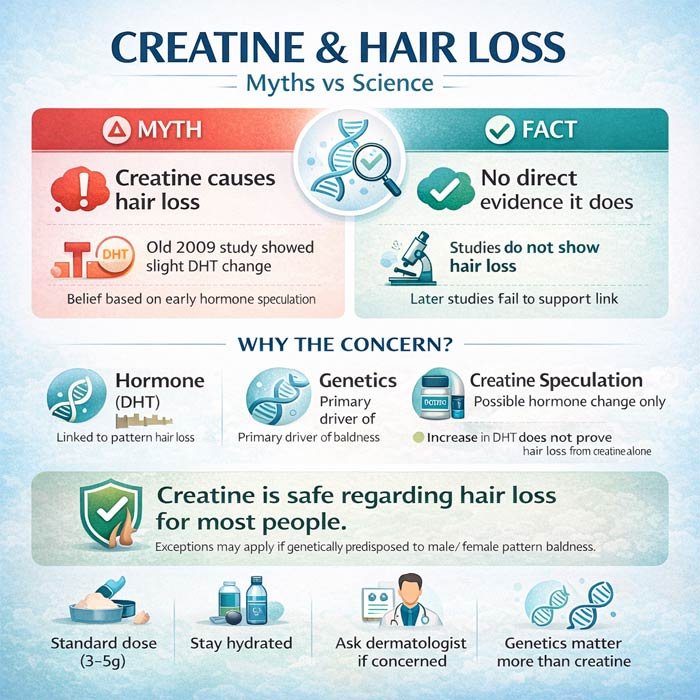
The straight answer to this lingering question is no, creatine doesn’t really cause hair loss. Current scientific research shows that there is no direct connection between creatine and hair loss. It was probably a myth that stemmed from one small study held in 2009.
The Scientific View
The study conducted in 2009 had college-going rugby players as participants who were required to take high doses of creatine. The researchers found that there was a spike in the levels of DHT or dihydrotestosterone during the 7-day loading phase of creatine intake. The DHT hormone is known to cause androgenetic alopecia, also referred to as male pattern baldness, among males who are genetically disposed. The major limitation of this 2009 study is that it did not consider the extent of hair thinning or loss experienced by the male rugby players. It focused on checking the hormone levels of men and found out that there was a hike in DHT levels, but within the normal range. Another limitation is that the sample size of this study is very small, as it had just 20 male players. So, it indicated that the result of the study was not accurate and required further studies.
What Did Subsequent Studies Reveal About Hair Loss and Creatine Link?
Various studies and comprehensive research after 2009 have shown that supplements with creatine did not have any adverse effect on DHT, free testosterone, and total testosterone levels in men [7]. A recent controlled study held in 2025 made a clear-cut assessment of men’s hair thickness, density, and health of follicular units among the participants who took 5 gm creatine every day for 12 weeks [8]. The researchers did not find any major differences in the parameters related to men’s hair and hormone range compared to their placebo counterparts. This explains why renowned sports organizations such as the International Society of Sports Nutrition have approved creatine as an effective supplement that is safe for use according to recommended guidelines [9].
Genetics Role in Hair Loss
Men’s hair loss, especially male pattern baldness, is primarily caused by genetics. Men who are genetically predisposed to develop patterned baldness are prone to face hair thinning irrespective of whether they take creatine or not. Sometimes, men facing heavy shedding even before taking a creatine supplement might also face hair loss. Some factors, like a bad lifestyle, low protein intake, poor diet, and stress, might also lead to hair loss in men.
Understanding DHT Levels and Their Role in Balding
DHT or Dihydrotestosterone is the main reason behind male pattern baldness, as this hormone combines with androgen receptors in follicular units, making it 5 times stronger than testosterone [10]. Such a bonding act triggers a series of cellular alterations, causing miniaturization of hair follicles, resulting in thinner and finer hair. This process also causes a decline in the hair growth phase, or anagen, and a longer resting phase called telogen, leading to gradual balding as the hair becomes shorter and thinner. Your genetics also determines the number of hair follicles responding to DHT hormone exposure. It would cause balding in the crown and front temples while not affecting the back and sides.
Men with androgenetic alopecia will have hair follicular units with hyperactivity of 5-alpha reductase and a spike in the density of androgen receptor [11]. This action in the follicles causes active conversion of testosterone into DHT, which will contribute to balding. Men with a genetic disposition are at a higher risk of developing pattern baldness caused by extreme hair loss when their DHT levels climb up than other males without a genetic disposition.
Creatine and Hair Loss: Myths vs. Facts
Myth 1: Creatine induces hair loss
Fact: No scientific evidence supports that hair loss is triggered by creatine supplementation, as it is based on hormones and genes [12].
Myth 2: High creatine doses will lead to severe hair thinning
Fact: It is safe to take the recommended 3 to 5 mg dose of creatine each day.
Myth 3: Creatine makes DHT levels higher to cause balding
Fact: Creatine may cause a slight increase in DHT levels, which is minor and will not harm hair [13].
Who Should Be Careful While Taking Creatine?
Though creatine is safe for all, some people should be careful while taking this supplement if:
- They have a family of men with male pattern baldness
- People who already have hair shedding or thinning issues
- People having hormone imbalances, PCOs, and thyroid dysfunction
- Those who have kidney-related issues, like impaired kidneys
- Men with liver issues should avoid metabolic strain
- Lactating and pregnant women
- People with bipolar condition
- Men taking specific medications like diuretics and NSAIDs
- Diabetic people
Safe Alternatives for Fitness Without Hair Concerns
If you are still concerned about taking creatine but looking for other alternatives without having to worry about hair, then choose any one from the list given below.
- L-carnitine supplements will help with recovery and energy metabolism
- BCAAs, or Branched-chain amino acids, will aid with muscle recovery
- Beta-alanine will help cut down fatigue and enhance endurance
But, it is essential to remember that creatine monohydrate is a highly researched, effective, and safe choice to improve workout performance and enhance body strength.
Wrapping Up
In short, there is not enough scientific evidence to support that there is a link between supplements with creatine and hair loss in healthy men. You will also realize that it is a well-researched supplement, making creatine an apt choice for improving your athletic performance.
Reference Links
- Kreider RB, Kalman DS, Antonio J, Ziegenfuss TN, Wildman R, Collins R, Candow DG, Kleiner SM, Almada AL, Lopez HL. International Society of Sports Nutrition position stand: safety and efficacy of creatine supplementation in exercise, sport, and medicine. J Int Soc Sports Nutr. 2017 Jun 13;14:18. doi: 10.1186/s12970-017-0173-z. PMID: 28615996; PMCID: PMC5469049. – https://pubmed.ncbi.nlm.nih.gov/28615996/
- International Journal of Sport Nutrition and Exercise Metabolism – https://journals.humankinetics.com/view/journals/ijsnem/28/2/article-p104.xml
- Kreider RB, Kalman DS, Antonio J, Ziegenfuss TN, Wildman R, Collins R, Candow DG, Kleiner SM, Almada AL, Lopez HL. International Society of Sports Nutrition position stand: safety and efficacy of creatine supplementation in exercise, sport, and medicine. J Int Soc Sports Nutr. 2017 Jun 13;14:18. doi: 10.1186/s12970-017-0173-z. PMID: 28615996; PMCID: PMC5469049. – https://pmc.ncbi.nlm.nih.gov/articles/PMC5469049/
- Cooper R, Naclerio F, Allgrove J, Jimenez A. Creatine supplementation with specific view to exercise/sports performance: an update. J Int Soc Sports Nutr. 2012 Jul 20;9(1):33. doi: 10.1186/1550-2783-9-33. PMID: 22817979; PMCID: PMC3407788. – https://pmc.ncbi.nlm.nih.gov/articles/PMC3407788/
- Wax B, Kerksick CM, Jagim AR, Mayo JJ, Lyons BC, Kreider RB. Creatine for Exercise and Sports Performance, with Recovery Considerations for Healthy Populations. Nutrients. 2021 Jun 2;13(6):1915. doi: 10.3390/nu13061915. PMID: 34199588; PMCID: PMC8228369. – https://pmc.ncbi.nlm.nih.gov/articles/PMC8228369/
- Yamaguchi S, Inami T, Ishida H, Morito A, Yamada S, Nagata N, Murayama M. The Effect of Prior Creatine Intake for 28 Days on Accelerated Recovery from Exercise-Induced Muscle Damage: A Double-Blind, Randomized, Placebo-Controlled Trial. Nutrients. 2024 Mar 20;16(6):896. doi: 10.3390/nu16060896. PMID: 38542807; PMCID: PMC10975653. – https://pmc.ncbi.nlm.nih.gov/articles/PMC10975653/
- van der Merwe J, Brooks NE, Myburgh KH. Three weeks of creatine monohydrate supplementation affects dihydrotestosterone to testosterone ratio in college-aged rugby players. Clin J Sport Med. 2009 Sep;19(5):399-404. doi: 10.1097/JSM.0b013e3181b8b52f. PMID: 19741313. – https://pubmed.ncbi.nlm.nih.gov/19741313/
- Lak M, Forbes SC, Ashtary-Larky D, Dadkhahfar S, Robati RM, Nezakati F, Khajevandi M, Naseri S, Gerafiani A, Haghighat N, Antonio J, Tinsley GM. Does creatine cause hair loss? A 12-week randomized controlled trial. J Int Soc Sports Nutr. 2025 Sep;22(sup1):2495229. doi: 10.1080/15502783.2025.2495229. Epub 2025 Apr 23. PMID: 40265319; PMCID: PMC12020143. – https://pubmed.ncbi.nlm.nih.gov/40265319/
- Buford TW, Kreider RB, Stout JR, Greenwood M, Campbell B, Spano M, Ziegenfuss T, Lopez H, Landis J, Antonio J. International Society of Sports Nutrition position stand: creatine supplementation and exercise. J Int Soc Sports Nutr. 2007 Aug 30;4:6. doi: 10.1186/1550-2783-4-6. PMID: 17908288; PMCID: PMC2048496. – https://pmc.ncbi.nlm.nih.gov/articles/PMC2048496/
- Randall VA, Thornton MJ, Hamada K, Redfern CP, Nutbrown M, Ebling FJ, Messenger AG. Androgens and the hair follicle. Cultured human dermal papilla cells as a model system. Ann N Y Acad Sci. 1991 Dec 26;642:355-75. PMID: 1809092. – https://pubmed.ncbi.nlm.nih.gov/1809092/
- Kaufman KD. Androgens and alopecia. Mol Cell Endocrinol. 2002 Dec 30;198(1-2):89-95. doi: 10.1016/s0303-7207(02)00372-6. PMID: 12573818. – https://pubmed.ncbi.nlm.nih.gov/12573818/
- Antonio J, Candow DG, Forbes SC, Gualano B, Jagim AR, Kreider RB, Rawson ES, Smith-Ryan AE, VanDusseldorp TA, Willoughby DS, Ziegenfuss TN. Common questions and misconceptions about creatine supplementation: what does the scientific evidence really show? J Int Soc Sports Nutr. 2021 Feb 8;18(1):13. doi: 10.1186/s12970-021-00412-w. PMID: 33557850; PMCID: PMC7871530. – https://pubmed.ncbi.nlm.nih.gov/33557850/
- American Hair Loss Association – https://www.americanhairloss.org






 Doctors Timetable
 Working Time