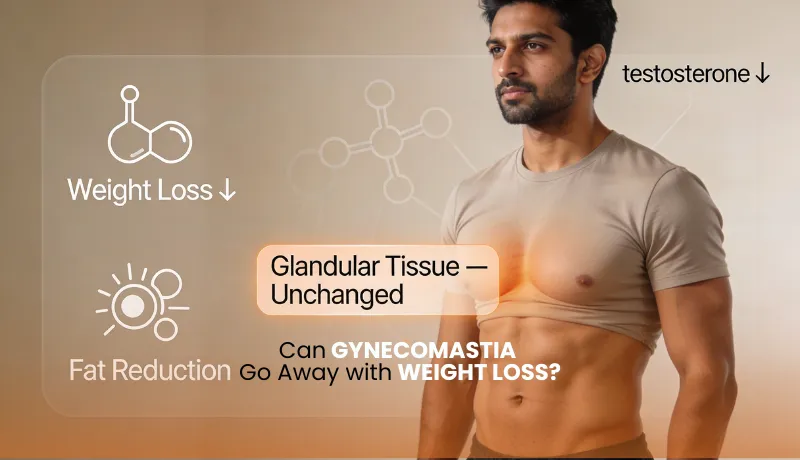
When looking at their body with enlarged breasts, many men might wonder whether losing excess weight would help them get rid of gynecomastia. Although vigorous workouts and a healthy diet can help other body parts appear slimmer, these activities cannot address the enlarged breast condition. This is because the relationship between breast tissue enlargement and fat loss is much more complex and needs medical intervention to resolve it. Gynecomastia is not caused by obesity or excess body fat but is the result of overgrown glandular tissue in the breast[1]. It makes your chest feel fuller and firmer with a rubbery feel instead of softness. This condition occurs due to the imbalance in hormone levels, which includes a higher estrogen level than testosterone. Your fat cells will reduce with a consistent workout regimen and diet, while glandular tissue remains unaffected with your weight loss efforts. Keep reading to know more about whether gynecomastia can be resolved naturally.
Gynecomastia vs Chest Fat – Know Your Enemy
Even though both chest fat and gynecomastia might have a similar look, some key differences help you distinguish them easily.
- Triggering Factors: You might develop gynecomastia when there is a severe variation in estrogen and testosterone levels. However, chest fat occurs due to your age and a bad lifestyle featuring poor nutrition and sedentary habits.
- Type of Tissue: Gynecomastia is often caused by overgrowth of glandular tissue, which, when pinched, might feel rubbery and firm. If you have excess chest fat, your breasts will feel jiggly and soft upon pinching them.
- Appearance: If you have gynecomastia, your chest will have a unique lump-like structure shaped like a disc below the breast or nipple. There would be no centralized mass if you have more chest fat, as it would be spread uniformly and look droopy or saggy.
- Placement: You may find a tiny disc-like lump that is solid to hold in and around the breast area. As your upper body will be muscular and soft, your chest will appear uniformly plumper.
- Symmetrical Look: As gynecomastia can be found in one or both breasts, there are higher chances of asymmetry. Chest fat, on the other hand, will make both sides look symmetrical due to widespread fat pockets.
- Sensitivity and Pain: You might feel slight pain or tenderness when trying to touch the enlarged breast area due to gynecomastia. There will be no pain or discomfort when touching the breast with excess chest fat.
- Reaction to Weight Loss: Gynecomastia will not shrink even when following a low-calorie diet and chest-strengthening workouts. Chest fat will come down drastically when following a fat-free diet and targeted workouts.
Why Diet Alone Can’t Melt Glandular Tissue
Dieting will not help treat gynecomastia, as it is the result of the presence of enlarged glandular tissue and not due to excess body fat. Even an extremely low-fat dietary plan will not help in melting the enlarged breast tissue because:
- Unlike chest fat, glandular tissues will not shrink with a healthy diet as they are fibrous, firm, and rubbery.
- Unlike others, gynecomastia might appear much more prominent after losing weight with a low-calorie diet. The stubborn breast tissue is firm and will be isolated under your nipple when chest fat decreases, and will have a protruded look.
- Even though a healthy eating pattern will help in restoring estrogen and testosterone balance, it will not be able to reverse the permanent enlargement changes in glandular tissue.
- If your puffy chest was caused by excess fat leading to pseudogynecomastia, it will respond to a healthy diet. But true gynecomastia is triggered by excess glandular tissue that needs a surgical procedure to remove it.
When Weight Loss Helps (And When It Doesn’t)
Pseudogynecomastia: When Weight Loss is Helpful
If your enlarged chest is a result of excess adipose fat, it can be referred to as pseudogynecomastia[2]. It is highly responsive to a calorie-deficient diet plan, and the fat cells will shrink like the fat in other body parts.
Gynecomastia: When Weight Loss Doesn’t Work
Due to the enlarged breast tissue, weight loss might not be useful to get rid of this condition. As the glandular tissue in the chest is fibrous, it will not burn like body fat[3]. Even if you achieve a low percentage of body fat, your breast gland will remain firm and lumpy.
Signs Your “Man Boobs” Aren’t Just Fat
- Perform a pinch test by pinching the muscle around the nipple. If you can feel a small disc-like lump that feels rubbery yet firm, it is glandular tissue growth.
- If your nipple and areola skin feel tender, sore, and painful, it indicates it isn’t fat but glandular tissue.
- As excess glandular tissue will be found just below the nipple, your chest will protrude or appear puffy.
- Even if you are undergoing rigorous weight training with targeted chest workouts, there will be no change with your man boobs, as it is glandular tissue and not fat.
Role of Hormones in Persistent Gynecomastia
- Estrogen Activity: Fluctuations in estrogen levels will cause enlargement of glandular tissue in the breasts, leading to gynecomastia. High estrogen levels might be caused by androgen conversion, which is caused by the aromatase enzyme in your adipose tissues[4].
- Deficiency in Androgen: Low levels of testosterone will affect the growth rate of breast tissues. These hormone levels will decline as you age, or when developing specific issues like hypogonadism[5]. It will cause a spike in estrogen hormones that will trigger the overgrowth of glandular tissue.
- Aromatase Action: The conversion of testosterone into estradiol is triggered by the aromatase enzyme. This activity happening in body fat leads to persistent gynecomastia will also cause a spike in estrogen levels.
- SHBG/ Sex Hormone-Binding Globulin: If you have hyperthyroidism or liver dysfunction, there would be a rise in SHBG levels. It will mingle with the testosterone hormone rather than estrogen, which would trigger enlargement of breast tissue.
Exercises That Improve Chest Shape (But Don’t Cure It)
These exercises will help enhance chest shape but will not help with gynecomastia.
- Chest Dips: It will help target your outer and lower pectoral muscles and will help achieve a defined look.
- Dumbbell Pullover: This workout will help expand and stretch your rib cage while helping you build the chest muscles.
- Incline Dumbbell Press: It targets the upper chest muscles and creates an enhanced look to create a balanced physique.
- Low to High Cable Crossovers: This exercise focuses on tightening the inner and upper chest muscle fibers and creates good definition.
- Incline and Standard Push-ups: It is useful for firming your overall chest profile and building a pectoral base.
Medical & Surgical Options After Weight Loss
Surgical Options include[6]:
- Excision Surgery: It is also referred to as subcutaneous mastectomy to eliminate rubbery and firm glandular tissue by making a tiny incision near the areola.
- Chest Lift: After tremendous weight loss, glandular tissue removal might make your skin look saggy or deflated. So, a male breast lift will be helpful to tighten loose skin and reposition the nipple and areola for a contoured look[7].
- Liposuction: It is useful for refining the chest contour and helps break down the chest fat to achieve a contoured look[8].
Medical Treatments include:
- Aromatase Inhibitors: Using specific aromatase-inhibiting medications will help in restricting the testosterone conversion into estrogen.
- Testosterone Replacement Therapy: After weight loss, it is essential to restore testosterone levels to prevent estrogen aromatization activity.
- SERMs: Taking Selective Estrogen Receptor Modulators[9] will help negate the effects of estrogen in the chest tissue to prevent enlargement[10].
The Honest Answer: Will It Ever Go Away Naturally?
In some cases, gynecomastia will naturally go away if detected early in teenagers undergoing puberty or newborns with inflamed breast tissue. However, gynecomastia will not go away if you have enlarged breast tissue for more than 2 years, among individuals taking supplements or specific medications. People diagnosed with pseudogynecomastia should resort to surgical procedures, as the glandular tissue will not shrink with weight loss or diet.
Now that you have undergone a massive weight loss transformation, but the protruding chest has become a concern, schedule an appointment with an Akruti specialist today!
Reference Links:
- Swerdloff RS, Ng JCM. Gynecomastia: Etiology, Diagnosis, and Treatment. [Updated 2023 Jan 6]. In: Feingold KR, Adler RA, Ahmed SF, et al.- https://www.ncbi.nlm.nih.gov/books/NBK279105/
- Theddeus Octavianus Hari Prasetyono, Illona Andromeda, Angelica Gracia Budhipramono, Approach to gynecomastia and pseudogynecomastia surgical techniques and its outcome: a systematic review, Journal of Plastic, Reconstructive & Aesthetic Surgery, Volume 75, Issue 5, 2022, – https://www.sciencedirect.com/science/article/abs/pii/S1748681522000791#preview-section-cited-by
- Cuhaci, Neslihan; Polat, Sefika Burcak; Evranos, Berna; Ersoy, Reyhan; Cakir, Bekir. Gynecomastia: Clinical evaluation and management. Indian Journal of Endocrinology and Metabolism 18(2):p 150-158, Mar–Apr 2014. | DOI: 10.4103/2230-8210.129104 – https://journals.lww.com/indjem/fulltext/2014/18020/gynecomastia__clinical_evaluation_and_management.4.aspx
- Shi, Z.; Xin, M. Endocrine Hormones and Their Impact on Pubertal Gynecomastia. J. Clin. Med. 2025, 14, 158. https://doi.org/10.3390/jcm14010158 – https://www.mdpi.com/2077-0383/14/1/158
- Johnson RE, Kermott CA, Murad MH. Gynecomastia – evaluation and current treatment options. Ther Clin Risk Manag. 2011;7:145-8. doi: 10.2147/TCRM.S10181. Epub 2011 Mar 28. PMID: 21479145; PMCID: PMC3071351.- https://pmc.ncbi.nlm.nih.gov/articles/PMC3071351/
- Shree P (2018) The Role of Steroids and Hormones in Gynecomastia-Factors and Treatments. J Steroids Horm Sci 9: 195. – https://www.iomcworld.com/open-access/the-role-of-steroids-and-hormones-in-gynecomastiafactors-and-treatments-17773.html#12
- Holzmer SW, Lewis PG, Landau MJ, Hill ME. Surgical Management of Gynecomastia: A Comprehensive Review of the Literature. Plast Reconstr Surg Glob Open. 2020 Oct 29;8(10):e3161. doi: 10.1097/GOX.0000000000003161. PMID: 33173677; PMCID: PMC7647635. – https://pmc.ncbi.nlm.nih.gov/articles/PMC7647635/#:~:text=Key%20data%20points%20included%20gynecomastia,INTRODUCTION
- Ciccarelli, F.; Moccia, F.; Vastarella, M.G.; Amoroso, A.; Vastarella, C.; Vastarella, V.; Pieretti, G. Glandular Transposition Technique for the Correction of Advanced Gynecomastia in Post-Bariatric Patients: A Case Series on a Conservative Strategy for Natural Aesthetic Outcomes. Medicina 2025, 61, 1842. https://doi.org/10.3390/medicina61101842 – https://www.mdpi.com/1648-9144/61/10/1842#:~:text=One%20patient%20required%20secondary%20revision,tissue%2Dpreserving%20surgery;%20plastic%20surgery
- Berger O, Landau Z and Talisman R (2022) Gynecomastia: A systematic review of pharmacological treatments. Front. Pediatr.10:978311. doi: 10.3389/fped.2022.978311 – https://www.frontiersin.org/journals/pediatrics/articles/10.3389/fped.2022.978311/full
- Maximov PY, Lee TM, Jordan VC. The discovery and development of selective estrogen receptor modulators (SERMs) for clinical practice. Curr Clin Pharmacol. 2013 May;8(2):135-55. doi: 10.2174/1574884711308020006. PMID: 23062036; PMCID: PMC3624793. – https://pubmed.ncbi.nlm.nih.gov/23062036/






 Doctors Timetable
 Working Time