Walking through the body transformation path can be both exhilarating and challenging, especially if you don’t have any idea about these procedures. Though there are several procedures for targeting and eliminating stubborn fat pockets, liposuction is the most commonly availed treatment. The term liposuction is an umbrella term that is used to refer to a fat removal procedure that also enhances your body contour. However, there are several liposuction methods that are useful for transforming your body within a few months. Of these, two well-known procedures are traditional lipo and VASER liposuction, which are adept at expelling unwanted stubborn body fat. Though these two liposuction procedures are effective in treating stubborn fat deposits, they are different in some significant ways. If you are planning to undergo liposuction, it is essential to learn the key differences between VASER vs traditional liposuction to make the best decision to achieve the desired contour.
Understanding Traditional Liposuction
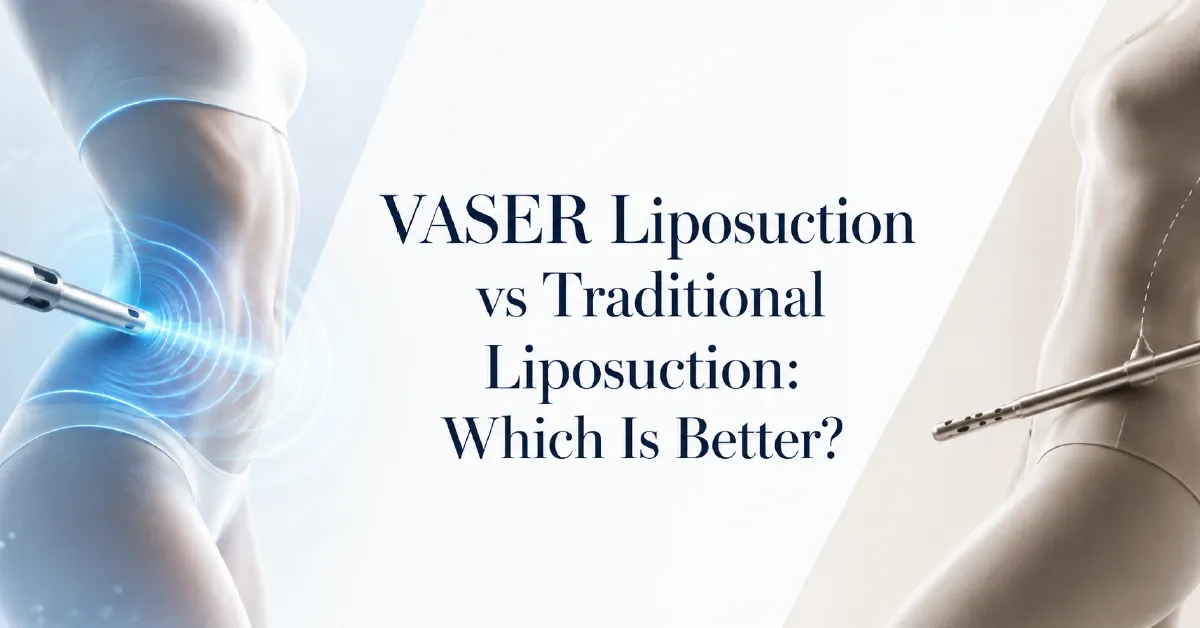
VASER vs traditional liposuction
Also referred to as SAL or suction-assisted liposuction, this traditional type of liposuction has been popular since the 1980s. This procedure uses a straightforward approach and is ideal for large body areas like your back, thighs, and abdomen. This method removes stubborn fat in a single session and has stood the test of time owing to its efficiency.
How Traditional Liposuction Works
This well-established fat removal method has evolved since its inception several decades ago and has been refined to make it more effective. This procedure begins by injecting a tumescent solution with a mixture of epinephrine, lidocaine, and saline. This type of liposuction utilizes a cannula that employs a suction method to penetrate into the fatty layer to dislodge it by following a to-and-fro thrusting method. However, traditional lipo doesn’t help with sculpting with precision and tightening loose skin in fibrous treatment areas, glandular tissue enlargement[1], and there isn’t better adipocyte viability while removing fat. Understanding such key limitations will be helpful when analysing VASER vs traditional liposuction.
Understanding VASER Liposuction
It refers to Vibration Amplification of Sound Energy at Resonance, which is considered a modern body contouring solution. It is a minimally invasive fat removal treatment that depends on ultrasound technology for emulsifying fat before extracting it. This treatment is performed by administering a tumescent solution with epinephrine, lidocaine, and saline. The surgeon will then insert a VASER probing device that delivers ultrasound waves to target the fat cells to liquefy them. This special device will not affect the surrounding connective tissues, blood vessels, and nerves and needs less mechanical effort when comparing VASER vs traditional liposuction to remove fat with high precision.
Working of VASER Liposuction
This type of liposuction is based on a combination of three mechanisms, which include [2]:
- Cavitation Mechanism: When performing VASER Liposuction, the ultrasound energy induces extreme pressure alterations, causing the membranes in the fat cells to collapse rapidly.
- Thermal Effect: The ultrasound produces controlled heat that stimulates dermal fibroblasts to create fresh elastin and collagen to retract skin after the procedure. This advantage is a notable point during the analysis of VASER vs traditional liposuction.
- Direct Mechanical Fragmentation: In this mechanism of VASER lipo, a probe is introduced into the treatment area to break down the fat while gaining acoustic energy benefits.
The triple mechanisms of VASER liposuction ensure the outcome delivered is much different than the traditional liposuction’s mechanical action.
VASER vs traditional liposuction: Notable Differences
-
Employment of Technology
Technology plays a key role in determining the differences between VASER vs traditional liposuction[3]. VASER lipo employs ultrasonic waves for breaking down the fat cells, making it a minimally invasive procedure when compared to the traditional method. A cannula is used to dismantle the fat cells physically in the traditional method, causing trauma to the tissues and skin surrounding it. In contrast, Vaser liposuction follows a targeted approach while maintaining the integrity of the skin, muscles, and tissue surrounding it.
-
Recovery Period
A major aspect when analysing VASER vs traditional liposuction is the recovery period after the procedure. As VASER lipo is a less invasive procedure, you will experience mild discomfort, swelling, and bruising. After undergoing traditional lipo, the recovery period will take longer. But you will have to wear compression garments for a couple of weeks to heal quickly and reduce swelling.
-
Precision Level and Contouring Effect
When discussing the level of precision between VASER vs traditional liposuction, modern lipo procedures like VASER work with high precision even while contouring body parts that need optimum sculpting[4]. You can opt for VASER liposuction for regions like flanks, chin, and belly where subtle fat removal might be required but demands optimum contouring. The traditional method is helpful to eliminate high fat volume, but its sculpting precision is not up to the mark.
-
Volume of Fat Removal
Both these fat removal procedures are effective in addressing stubborn fat pockets, but they are suitable for people having varying fat volume removal needs. Traditional type of liposuction is a popular choice for people who need a high amount of fat removal, specifically between 4 and 5 liters per session. As traditional liposuction is based on mechanical principles, it is an effective choice to extract stubborn fat in high volumes. Vaser lipo is excellent in removing moderate to small amounts of stubborn fat while maintaining perfect precision. The contouring precision of Vaser lipo makes people prefer it over the traditional method when a huge amount of fat removal is needed.
-
Recovery Experience: Downtime & Pain
VASER liposuction is efficient in extracting stubborn fat ranging between moderate to small volume with excellent precision. You will experience mild swelling and bruising after Vaser liposuction, as the ultrasound technology employed will be gentler on the tissues and skin than a traditional procedure[5]. Plus, there will be less post-op discomfort, a better recovery rate to resume regular work, and minimal pain when the skin heals.
The recovery rate of traditional liposuction is much slower, as mechanical fat removal causes trauma to surrounding skin and tissues. So, it is natural to face extensive discomfort, bruising, and swelling after liposuction. You might need about a week to recover and get back to routine work, but wait for more weeks before indulging in rigorous workouts. You will have to wear compression garments for a longer period than patients who have undergone Vaser liposuction.
-
Safety Aspect
When discussing the safety range between VASER vs traditional liposuction, you must understand that both these fat removal procedures are very safe when operated by a board-certified surgeon like Dr. Ram Bhupal Rao, at Akruti Plastic & Cosmetic Surgery Centre. Traditional lipo has several decades of scientific data and research proving its effectiveness and safety. Major risks will range from anaesthesia reactions, contour irregularity, bleeding, accumulation of fluid, to infection. However, as it is an invasive procedure, there are chances of high blood loss when fat removal is in process, which will be handled expertly by Dr. Ram Bhupal Rao, a renowned surgeon in Hyderabad. The gentle approach followed by Vaser lipo’s ultrasound energy gives it a safety advantage. This procedure doesn’t cause any bleeding, keeps nerves and blood vessels intact, lowers complication risks, and results in minimal blood loss[6].
-
Outcomes & Effectiveness
Both these fat removal procedures are developed to offer excellent outcomes even though the procedure and outcome timeframe tend to differ. Vaser lipo offers a refined look with excellent skin tightening and smoother skin. This modern procedure keeps fibrous tissue intact, offering natural contours and tighter skin. The outcomes of Vaser lipo will be visible within a couple of weeks, and the outcome will be noticeable between 3 and 6 months after residual swelling goes down. Traditional liposuction exhibits massive fat volume reduction and has achieved optimum patient satisfaction across the globe. Though the results of traditional lipo will take a bit longer to become visible owing to extreme swelling, the outcome will be impressive, especially if high fat removal is performed. Final outcomes of traditional liposuction will take between 6 months and 12 months.
Which Fat Removal Procedure is Right for You?
Selecting between traditional liposuction and Vaser liposuction will be based on specific body contouring objectives, the volume of fat removal, and the recovery period you are willing to spend. You can opt for Vaser liposuction when:
- You need a sculpted body with high-definition muscles or athletic physique
- Fat removal is needed from fibrous or delicate body parts
- Body parts have moderate stubborn fat pockets
- Require an easier and shorter recovery time
- Have better skin elasticity
Traditional lipo will be suitable if you:
- Require high volume fat removal
- Are on the lookout for a procedure with a positive track record
- Are open to a flexible recovery period
- Are looking for an affordable fat removal procedure
Wrapping Up
While analysing VASER vs traditional liposuction, the choice of the right procedure usually relies on your specific objectives and aesthetic concerns. Both these fat-removing treatments are effective and minimally invasive, created for eliminating unwanted and stubborn fat deposits. If you are seeking a solution to rectify loose skin, detailed contouring outcomes, and fibrous tissue concerns, you can opt for a high-precision procedure like Vaser lipo. But traditional lipo is a reliable choice and proven for its effectiveness, especially for patients with high-volume fat removal needs. Consult Dr.Ram Bhupal Rao, the board-certified surgeon at Akruti Plastic & Cosmetic Surgery Centre today to embark on a safe and effective body contouring and sculpting journey.
Reference Links:
- Ouf MAA, Kishk TFAEH, Elnahas MA. Evaluation of Traditional Liposuction, VASER Liposuction, and VASER Liposuction Combined with J-plasma in Management of Gynecomastia. Plast Reconstr Surg Glob Open. 2024 Nov 20;12(11):e6277. doi: 10.1097/GOX.0000000000006277. PMID: 39568685; PMCID: PMC11578192. https://pmc.ncbi.nlm.nih.gov/articles/PMC11578192/
- Kandulu, Hüseyin. (2024). Evaluation of Postoperative Complications in VASER<sup>®</sup>-assisted Liposuction: A Retrospective Study of 1,486 Cases. Namık Kemal Tıp Dergisi. 12. 61-66. 10.4274/nkmj.galenos.2024.59354. https://www.researchgate.net/publication/379217364_Evaluation_of_Postoperative_Complications_in_VASERR-assisted_Liposuction_A_Retrospective_Study_of_1486_Cases
- Nagy MW, Vanek PF Jr. A multicenter, prospective, randomized, single-blind, controlled clinical trial comparing VASER-assisted Lipoplasty and suction-assisted Lipoplasty. Plast Reconstr Surg. 2012 Apr;129(4):681e-689e. doi: 10.1097/PRS.0b013e3182442274. PMID: 22456382. https://pubmed.ncbi.nlm.nih.gov/22456382/
- Atieh B, Baajour J, El Merkabaoui H, Makkawi K. Literature Review and Evidence-Based Comparative Analysis of Traditional Suction-Assisted Lipectomy (SAL) vs. Ultrasound-Assisted Liposuction (UAL) Reported Outcomes. Aesthetic Plast Surg. 2025 Aug;49(16):4648-4655. doi: 10.1007/s00266-025-04872-2. Epub 2025 Apr 23. PMID: 40268767. https://pubmed.ncbi.nlm.nih.gov/40268767/
- Tran BNN, Didzbalis CJ, Chen T, Shulzhenko NO, Asaadi M. Safety and Efficacy of Third-Generation Ultrasound-Assisted Liposuction: A Series of 261 Cases. Aesthetic Plast Surg. 2022 Oct;46(5):2310-2318. doi: 10.1007/s00266-022-02992-7. Epub 2022 Jul 27. PMID: 35896731. https://pubmed.ncbi.nlm.nih.gov/35896731/
- Márquez-Gutiérrez, E. A., Tamez-Pedroza, L., Morales-Naya, E. D., Vélez-Palafox, M., Cuartero-Castro, G., Zacaula-Juárez, N., Sánchez-Sánchez, R., & González-Torres, M. (2024). A randomized intraindividual comparative study evaluating the effects of two ultrasound-assisted liposuction devices on the abdomen. Journal of Plastic, Reconstructive & Aesthetic Surgery, 94, 20–26. https://www.sciencedirect.com/science/article/pii/S1748681524002249






 Doctors Timetable
 Working Time