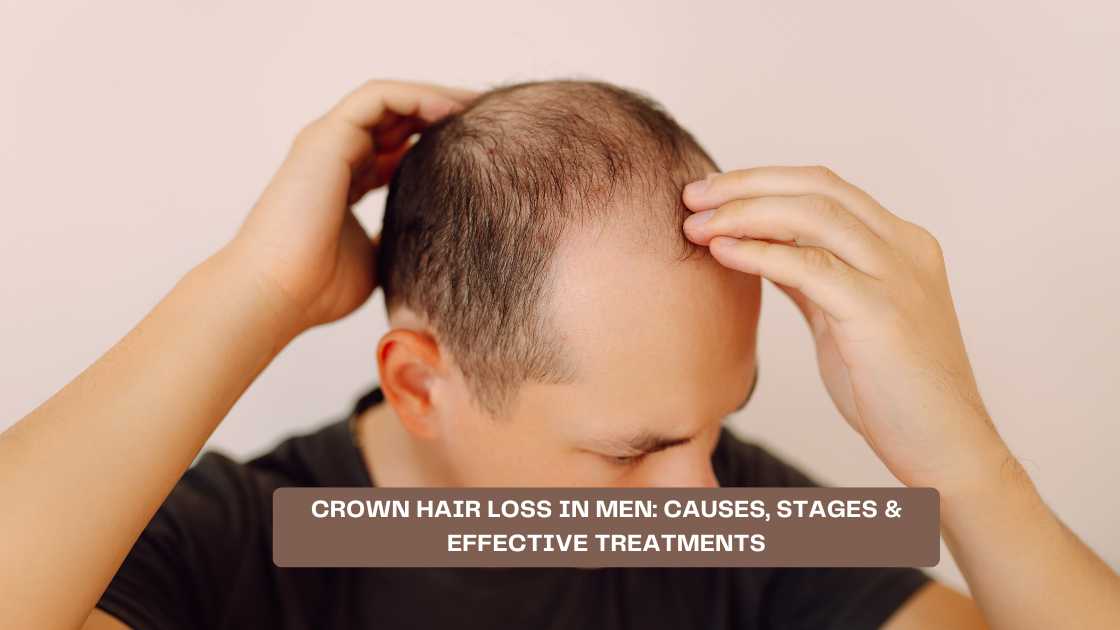
Losing hair in the crown area is a common issue faced by males worldwide, with many experiencing it as early as their 20s. Being the highest point of the body, the crown area remains one of the most challenging parts to examine. This explains why hair loss at the crown is often overlooked and is identified only after it has progressed to a certain degree. Though crown hair loss can occur at any point in time, it can be depressing and frustrating once you spot it. This type of hair loss will be visible only when you pull your hair or notice thinning patches in the crown. Hair loss and thinning at the crown are often indicators of the onset of male pattern baldness, which is influenced by hormonal changes, poor lifestyle habits, and genetics. Understanding the major causes, stages of crown hair loss, and ways to treat them is important for protecting hair and preventing further progression. Identifying crown hair loss at an early stage and treating it can make a huge difference, as it cannot only slow but also halt hair loss.
What Is Crown Hair Loss? Understanding the Basics
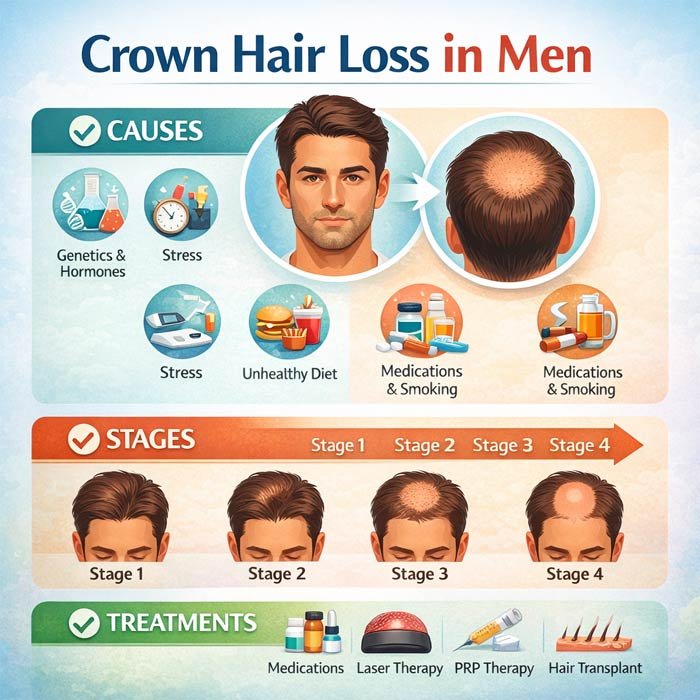
Hair loss at the crown follows a specific pattern among males. It is often identified only after it progresses, with hair density decreasing at the scalp’s crown. This condition is also called vertex balding or vertex thinning. It is a hallmark indicator of male pattern baldness [2] or androgenetic alopecia [3]. The pattern of loss differs among men. Some have thinning in different crown areas, while others have a receding hairline along with crown hair loss [4]. Early signs can be spotted by watching for these changes:
- Your hair parting grows wider every day
- Your scalp becomes much more visible, especially after a shower or oiling
- The swirl pattern at the back looks thinner with sparse hair
- You feel less hair when running your fingers through the crown
Why Does Crown Hair Loss Happen? Major Causes
Here’s a list of some of the major causes behind crown hair loss:
- Heredity & Genetics: One of the key causes behind hair loss in the crown area is genetic predisposition [5]. If any family member has male-pattern baldness, you are more likely to experience crown hair loss.
- Change in Hormone Levels: Imbalances in hormone levels have a crucial role in causing crown hair loss in males. An increase in DHT or Dihydrotestosterone, a testosterone byproduct, will lead to shrinkage of follicular units, especially in the crown. A spike in your DHT levels as you get older will weaken the hair follicles and cause crown balding with sparse hair growth.
- Aging: As men grow old, their crowns become much more visible owing to slow hair growth. As their hormone levels decline, the follicles begin to produce very fine hair, resulting in lower density and a more visible scalp. Most males begin to develop signs of crown balding by the time they reach 20 or 30 years old [6].
- Scalp Issues: Men who have scalp conditions like chronic inflammation, seborrheic dermatitis, and psoriasis will face decreased hair growth in the crown area when not treated.
- Stressful Lifestyle: Not sleeping properly and experiencing a high level of stress at the workplace or in personal life might contribute to crown hair loss in men. Even though they are not direct contributing factors, they might accelerate your hair loss process. Too much psychological stress can contribute to hormonal fluctuations and cause hair thinning by reducing blood circulation and damaging follicles.
- Health Conditions: Specific health issues, such as scalp infections like alopecia areata and hypothyroidism, will lead to hair loss and eventually lead to male pattern baldness.
- Environmental Factors: Using hair products with harsh chemicals or too much use of hair styling tools might cause damage to both scalp and hair, leading to crown hair loss.
- No Nutrition: Deficiency of nutrition caused by a poor diet might make your body lack essential minerals and vitamins like B and D vitamins, leading to crown balding [7].
Crown hair loss has specific stages. These are measured by the Norwood-Hamilton scale to assess severity [8]. Knowing these stages will help you choose the right treatment.
1st Stage – No Major Hair Loss
During this stage, the scalp appears fuller, with no signs of thinning or a receding hairline. During this base stage, your hair will appear even across the crown with no significant changes, but you might face slight hair fall. This stage doesn’t need any specific treatment as there is no visible hair loss. However, you can take preventive steps, such as managing stress and eating a healthy diet.
2nd Stage – Subtle Hair Recession
At this stage, you might notice a slight temple recession. This marks the start of hair loss. Your hairline may form a subtle M shape above the forehead. Oral and topical medications can help correct this stage.
3rd Stage – Severe Balding
This stage is marked by visible recession along the forehead and temples, with hair thinning at the crown. Your hairline recession will have developed a clear V- or U-shaped pattern at this stage of crown balding. Your doctor might suggest topical medications and minimally invasive therapies to protect existing hair and to encourage hair growth.
4th Stage – Progressive Hair Loss
By this stage, hair recession is severe. Few or no strands remain at the vertex crown. The temple hairline is much more visible. A narrow hair band might connect both sides as hair falls out at the crown. A partial hair transplant could be a good choice here.
5th Stage – Extreme Hair Loss
Your hair loss will advance further, creating a horseshoe-like pattern. Your crown becomes much more visible, along with a receding hairline above the forehead and temples. The scalp becomes completely bald, and a tiny hair band will be visible. Your doctor will recommend a hair transplant procedure, such as DHI, to restore hair.
6th Stage – Extensive Balding
During this crown balding stage, scalp hair loss will increase, contributing to a larger horseshoe pattern. Very little hair will be left in your crown, and hair thinning will spread across the head. To treat this stage, Follicular Unit Extraction or FUE transplant will be suggested.
7th Stage – Complete Crown Balding
At this 7th stage of crown balding, men will experience complete baldness, and the sides and back of their head will be connected by a fine band of hair. Hair transplants might be challenging during this stage of crown hair loss, as there will be fewer donor areas with healthy hair follicles. The FUT hair transplant technique will be useful during this stage of crown hair loss.
Best Crown Hair Loss Treatments Available Today
- For 1st and 2nd stage of crown hair loss, topical medication like minoxidil and oral finasteride will help slow down the rate of hair loss. It will also kindle hair growth by curbing DHT production and stopping the shrinkage of follicles [9].
- For the 3rd to 5th stage of crown balding, your doctor will suggest low-level laser therapy for stimulating follicles and promoting scalp health. PRP therapy will also help promote hair growth by rejuvenating and refreshing hair follicles through the injection of your blood plasma. A partial hair transplant, like FUE, will also help restore hair.
- For stages 6 and 7, advanced hair transplant techniques like DHI, FUT, or FUI will be suggested by your surgeon to tackle advanced hair loss at the crown.
Hair Transplant for Crown Area: Is It Effective?
Hair transplant techniques have gained a reputation for their effectiveness in restoring hair among men facing crown hair loss or balding. These advanced procedures are usually performed to enhance your hair volume and density, offering excellent coverage in balding areas. It involves extracting healthy hair follicles from the scalp with high-density hair growth and transplanting them to the crown area with visible balding and hair thinning. FUT (follicular unit transplantation), DHI (direct hair transplantation), and FUE (follicular unit extraction) are popular hair restoration techniques. These transplant techniques ensure excellent hair growth results, with a high graft survival rate when performed by an experienced surgeon. You can start noticing visible hair growth after a few months after the transplantation.
However, you must wait for 9 to 12 months to notice complete hair growth results, as the new follicles must settle down in the recipient site and go through the shedding/shock phase before growth. However, it is essential to understand that males with complete crown balding and advanced hair loss are not candidates for hair transplant, as it requires healthy follicular units for optimal results. Schedule a consultation with Akruti hair specialist today to treat crown hair loss effectively.
Reference Links
- American Hair Research Society – https://americanhairresearchsociety.org/male-pattern-hair-loss/
- Ho CH, Sood T, Zito PM. Androgenetic Alopecia. [Updated 2024 Jan 7]. In: StatPearls [Internet]. Treasure Island (FL): StatPearls Publishing; 2025 Jan-. Available from: https://www.ncbi.nlm.nih.gov/books/NBK430924/ – https://www.ncbi.nlm.nih.gov/books/NBK430924/
- Hoover E, Alhajj M, Flores JL. Physiology, Hair. [Updated 2023 Jul 30]. In: StatPearls [Internet]. Treasure Island (FL): StatPearls Publishing; 2025 Jan-. Available from: https://www.ncbi.nlm.nih.gov/books/NBK499948/ – https://www.ncbi.nlm.nih.gov/books/NBK499948/
- Harvard Medical School – https://www.health.harvard.edu/a_to_z/hereditary-patterned-baldness-a-to-z
- Springer Science+Business Media New York 2017 – https://art.torvergata.it
- Jodrell Science Laboratory, Royal Botanic Gardens, Kew, Richmond, TW9 3AB, London, UK – https://www.sciencedirect.com/science/article/abs/pii/S0924224421004362
- Gupta M, Mysore V. Classifications of Patterned Hair Loss: A Review. J Cutan Aesthet Surg. 2016 Jan-Mar;9(1):3-12. doi: 10.4103/0974-2077.178536. PMID: 27081243; PMCID: PMC4812885. – https://pmc.ncbi.nlm.nih.gov/articles/PMC4812885/
- Piraccini BM, Blume-Peytavi U, Scarci F, Jansat JM, Falqués M, Otero R, Tamarit ML, Galván J, Tebbs V, Massana E; Topical Finasteride Study Group. Efficacy and safety of topical finasteride spray solution for male androgenetic alopecia: a phase III, randomized, controlled clinical trial. J Eur Acad Dermatol Venereol. 2022 Feb;36(2):286-294. doi: 10.1111/jdv.17738. Epub 2021 Oct 25. Erratum in: J Eur Acad Dermatol Venereol. 2023 Feb;37(2):452. doi: 10.1111/jdv.18750. PMID: 34634163; PMCID: PMC9297965. – https://pmc.ncbi.nlm.nih.gov/articles/PMC9297965/






 Doctors Timetable
 Working Time










Comments
[…] hair loss can affect different parts of the scalp. Learning about crown hair loss in men can help you recognise common thinning […]